Starlink Mini off a battery: real internet when the grid and cell are both down
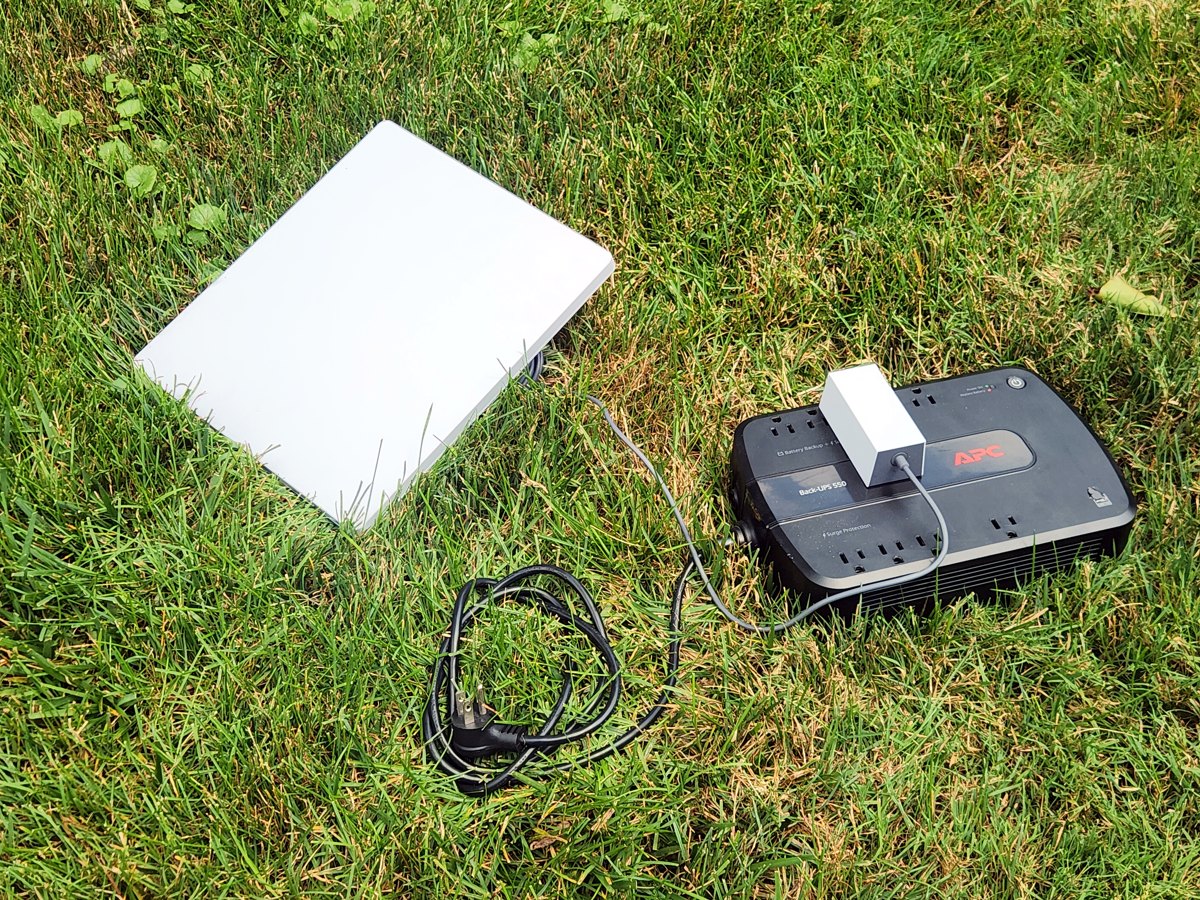
Most of this site is about receiving - a radio pulls information in when nothing else can. But sometimes you need the internet itself back: to reach family, get back to work, or just let people know you're safe when a storm has taken out the cell towers and the cable line. The Starlink Mini is the best consumer answer to that. It's a flat white panel about the size of a 1980s Trapper Keeper - for the Gen X kids out there - so it slides right into a backpack, and it will run off a battery. This page covers the honest runtime numbers and the one piece of gear that makes it practical - a battery backup you should own anyway.
The battery that doesn't look like prepping
Start with the least dramatic device in this whole site: a small uninterruptible power supply (UPS) - the kind that looks like a chunky power strip. You buy one for entirely ordinary reasons. It protects your computer, TV, and network gear from the voltage spikes and brownouts a storm throws at your wiring (the "dirty power" that quietly shortens the life of electronics). It keeps your desktop and Wi-Fi alive through the two-second flickers that would otherwise reboot everything. It is, day to day, just good household sense - nobody looks at a UPS and thinks bunker.
And then, in an actual outage, you unplug it and it becomes a grab-and-go battery - which is exactly what the photo above shows. The APC Back-UPS 550 (Amazon) in the photo holds a 12-volt, roughly 7-amp-hour battery (about 86 watt-hours) behind a normal wall outlet. That is enough to run a Starlink Mini for a useful stretch. One purchase, three jobs: surge protection, ride-through backup, and emergency power source. That is the whole ethos of this site in a single grey box - buy the thing that earns its place before the emergency, and is ready when one comes.
How long will it actually run?
The Starlink Mini draws about 20-40 watts - roughly 25W sitting idle, 30-40W in active use, with brief momentary peaks higher. Against the Back-UPS 550's ~86 watt-hours, derated honestly for the fact that you never fully drain a lead-acid battery and the inverter isn't free (you get maybe 60-70% of the nominal energy to the device), the real numbers land here:
| Mini power draw | Back-UPS 550 runtime |
|---|---|
| ~25 W (idle) | ~2 - 2.4 hours |
| ~30 W (typical) | ~1.8 - 2 hours |
| ~40 W (busy) | ~1.4 - 1.5 hours |
So the honest headline: a small home UPS runs a Starlink Mini for roughly one and a half to two hours.
That is not days of off-grid internet - it's a bridge. Enough to get online during the worst of a storm, tell people you're safe, pull down radar and news, and get back off. For a short outage, that bridge is often all you need. Your exact runtime will vary with the specific UPS, the age of its battery (a three-year-old UPS battery delivers noticeably less than a new one), and the Mini's draw in cold weather.
When you need real duration
For hours instead of an afternoon, the same math points at a bigger battery. A portable power station (Amazon) - a lithium unit from roughly 300 to 1000 watt-hours - runs the Mini about eight to thirty hours on a charge (a ~300Wh unit near the low end, a ~1000Wh unit at the top), and most can be topped back up from a car or a folding solar panel. That is the difference between riding out a storm and staying connected through a multi-day outage. It costs more and it is a deliberate purchase, not an impulse one - but it is the honest answer to "keep the internet on for days," and it doubles as the power source for your phones, lights, and radios at the same time.
The plan detail nobody mentions
Here is the preparedness insight buried in Starlink's pricing: the Mini's most basic plan is about $10 a month (it launched lower and has moved around), and - critically - you can pause it between disasters. You buy the hardware once, keep the dish in a closet, and activate the service only when you need it. That turns Starlink from a $100-plus monthly commitment into a dormant capability you switch on the week a hurricane is forecast. For an emergency tool, pay-only-when-needed is exactly the right shape.
If you do decide to get one, signing up through this referral link (Starlink) gets you a free month of standard service to start - and, disclosed plainly, credits this site a month too. It's one of the rare cases where the link is a discount for you as much as support for the page. (Buy the dish on starlink.com through it, not through a reseller, for the credit to apply.)
The honest limits
This is the strongest tool on the site, and the most expensive - so the caveats matter:
- It is not radio. Everything else here works with no infrastructure at all; Starlink needs its satellites and a clear view of the sky. It is the "internet back" option, not the "communicate when everything is gone" option. Keep a weather radio and a plan on paper as the layer beneath it.
- The hardware isn't cheap. This breaks this site's usual "one afternoon, under $100" rule - the Mini is a few hundred dollars before service. It is the premium capability, not the first thing to buy. Do the free and cheap essentials first.
- It needs sky and power. A clear northward view and a charged battery. Both are easy to forget until the moment you need them, so test the whole setup - dish, cable, UPS - on a calm day, not during the storm.
Bought for the right job and kept ready, a Starlink Mini and a battery are the closest thing there is to carrying the internet in a backpack. Just remember it rides on top of the simpler layers, never instead of them.