
The Technician license: what the exam is like and what it unlocks
Every guide on this site eventually points at the same door: the amateur radio license. The door isn't locked. The exam requires no radio background, no electronics, and no math beyond arithmetic - it tests whether you prepared, not whether you're an engineer.
What the exam is like
- You don't need to know radios to start. The study materials assume zero background. Grade-schoolers pass this exam; so do grandparents who've never soldered a wire.
- 35 multiple-choice questions; 26 passes. No essays, no practicals - and most sessions let you retake on the spot if you miss.
- Every question is published in advance - read the official pool yourself. All 409, exact wording, exact choices; your 35 come from nowhere else. (Current pool: July 2026 - June 2030.)
- No Morse code. The requirement was dropped in 2007, at every license level - if that's what was holding you back, not to worry.
- Barely any math, no circuit analysis. Plain-English rules, practices, and safety, plus a few one-step arithmetic questions - calculators allowed. The entire pool contains three diagrams, all name-that-symbol.
- The cost: a ~$15 exam-session fee to the volunteer examiners plus the $35 FCC application fee - about $50 all-in. The license is good for ten years and renews free.
- Where: local radio clubs run in-person sessions, and fully remote online exams are routine now. The ARRL's licensing pages list both.
Most people prepare in a weekend to two weeks: study until practice exams score 85%+, then book a session. Our pick is Michael Burnette's Fast Track (Amazon) audiobook - it teaches the why behind each answer, and commutes count as study time. Whatever you pick, make sure it covers the 2026-2030 pool; editions for the old one are still floating around.
Do you need a paid course? No.
There's a small industry of paid online ham-license courses, and you can skip every one of them. The exam is built to be self-taught: the full question pool is public (linked above), free sites like HamStudy.org drill you on the exact questions until you're scoring 85%+, and one good study book fills in the why.
I did it exactly that way, and it's the better road. A course sells you structure, but structure you didn't build yourself doesn't survive contact with the air, and the air is where the real competence comes from. Read enough to pass, sit the exam, then learn the actual skill the way every operator does: on the radio, one weekly net at a time.
Burnette wrote a Fast Track for every class - Technician, General, and Extra - so the same plain-English approach carries you up the ladder, without ever paying for a course.
What the license unlocks
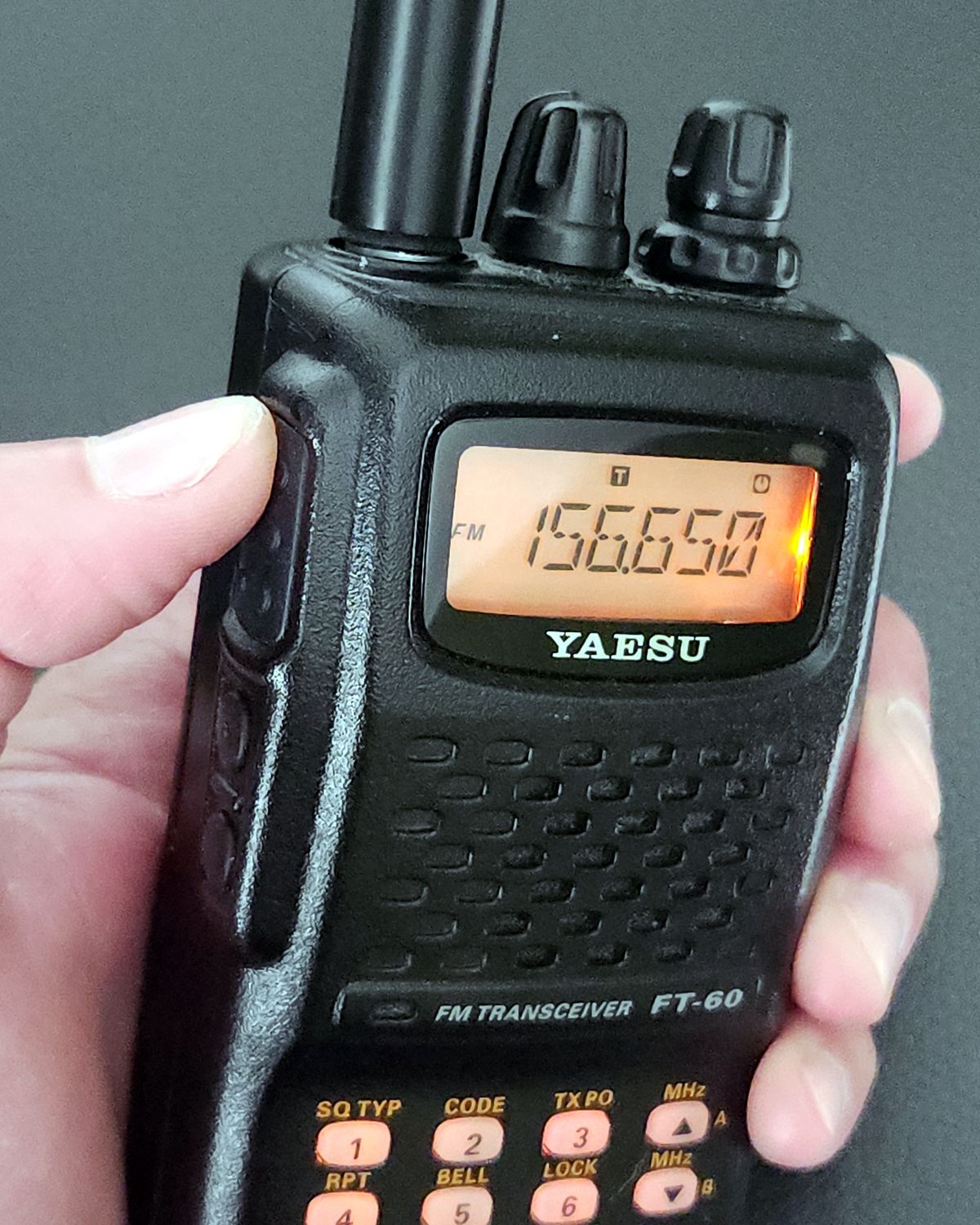
The handheld in the photo is a Yaesu FT-60R - in production for two decades because it is simple, rugged, and hard to outgrow. Its one real drawback is tedious keypad programming, best done once with free software on a calm day rather than under a storm. Check current price (DX Engineering)
A Technician license grants:
- All amateur VHF and UHF privileges - the 2-meter and 70-centimeter bands where local ham life happens: repeaters (community-maintained towers, many with backup power, that let a handheld talk across a county), simplex radio-to-radio, and the weekly nets where the skill actually gets built.
- Real long-distance HF, in a slice. Technicians get voice privileges on part of the 10-meter band - and when that band opens, a modest station talks across oceans, no infrastructure involved.
- The digital modes - the weak-signal machinery that turns a few watts into continent-crossing contacts, plus packet, APRS position reporting, and more.
- Satellites. Amateur satellites pass overhead daily, and working one takes little more than a handheld and patience. The International Space Station carries an amateur station; licensed operators contact it.
- Emergency traffic, legitimately. A license makes you someone who can check into ARES, SKYWARN®, and SATERN nets, pass traffic when regions go dark, and practice all of it legally beforehand.
- The right to build and experiment - homebrew antennas, transmitting SDRs, high-power amplifiers.
Two more exams up the same ladder - General, then Extra - open the rest of the HF bands. But Technician is where every ham starts, and for family emergency communications it covers the realistic need.
The fine print
The exam is the easy part, and passing it produces a learner's permit, not a skill. The capability this site keeps talking about - the layer that works when everything is down - is built afterward, on the air, a weekly net check-in at a time. If that sounds like a chore, FRS/GMRS plus a weather radio covers most families, license-free. If it sounds like it might be fun, it is - and the emergency capability arrives as a side effect of the hobby.