
Principles of radio: everything important fits in a Boy Scout crystal set
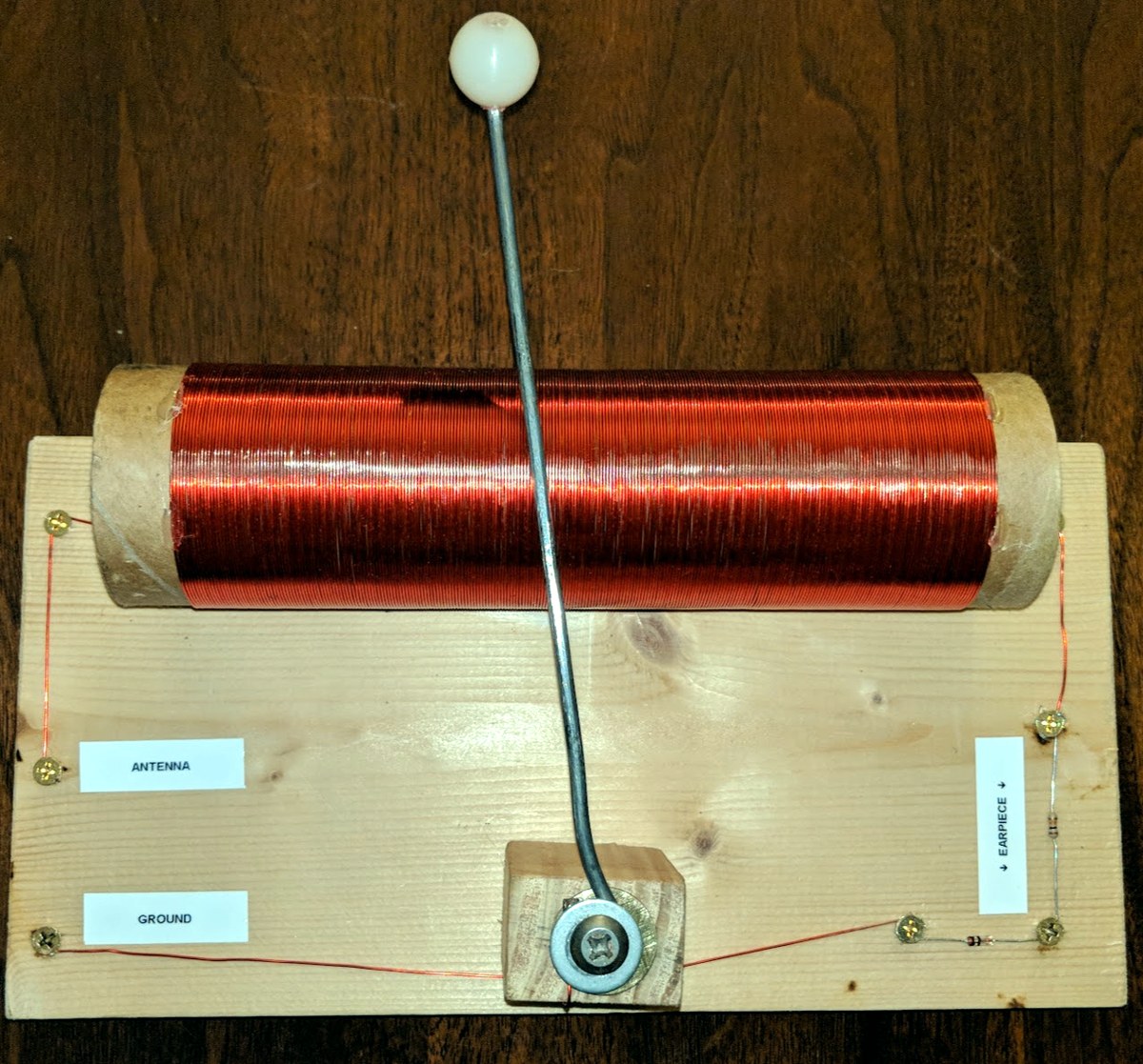
I built the crystal set in the photo above: a coil of wire, a diode, an earphone, and a long piece of wire out the window. No battery. No plug. It plays anyway - powered by nothing but the radio station itself. It's the classic Boy Scout pattern, the build generations of scouts learned radio on, and it's still the best radio lesson I know, because everything a modern receiver does is hiding inside it in plain sight. This page teaches radio the way that build teaches it: with four parts you can hold in your hand.
A radio wave is energy arriving at your house
A transmitter pushes current up and down its antenna thousands to millions of times per second, and that motion launches an electromagnetic wave - the same family as light, just far slower in rhythm. The wave spreads out and washes over everything: your house, your car, the wire fence out back. Wherever it crosses a conductor, it drags the electrons in that conductor up and down in the same rhythm.
A radio wave doesn't carry a message the way mail does - it delivers actual electrical energy. Tiny amounts, but real. A strong AM station induces enough energy in 50 feet of wire to physically move an earphone diaphragm. The crystal set is the proof: it has no other power source.
Modulation: how a wave carries a voice
A steady wave at one frequency - a carrier - says nothing; it's a blank canvas at, say, 1020 kHz. To make it carry sound, you vary it in step with the sound. That varying is modulation. There are only a few things about a wave you can vary, which is why there are only a few answers:
- AM (amplitude modulation) varies the wave's strength. Loud moments in the studio make the carrier momentarily stronger, quiet moments weaker - the audio rides on the wave as an envelope, like a ribbon's edge tracing a profile. It is simple to create and simple to decode.
- FM (frequency modulation) keeps the strength constant and varies the frequency - wiggling faster and slower around its center in step with the sound. Immune to the crackle of static (which is an amplitude effect), which is why music went there. But decoding FM takes real circuitry.
- CW (continuous wave) varies nothing at all. The carrier is simply switched on and off, and the meaning lives in the lengths and the silences - Morse code. Because every watt goes into one narrow note instead of being spread across a voice, it gets through when nothing else will.
Watch the same message go down all three at once. The top trace is what we want to send; below it, the wave that actually leaves the antenna in each case.
The dotted outline is the message itself, riding on the wave as its envelope. The rate never changes. A lightning crash is also a change in height, which is why AM hisses and pops.
The height never changes. The wave bunches up and stretches out instead. A receiver that ignores height ignores most static along with it.
No shape to read at all, only timing. The edges are deliberately softened; switching a transmitter abruptly splatters clicks across the band.
The carrier here is slowed enormously so you can see individual waves. A real one at 7 MHz completes seven million cycles a second, and a voice riding on it varies thousands of times more slowly still - so the shapes are drawn accurately, but nothing is to scale in time.
A crystal set can only decode AM. Point one at CW and you do hear something - a click as the key goes down and another as it lifts - because the diode follows the envelope, and switching a carrier on and off is all envelope. What you don't get is the musical tone an operator listens for. That needs a small oscillator inside the receiver, beating against the incoming signal to produce an audible note - and an oscillator needs power, which a crystal set does not have.
The four parts
1. The antenna - a long wire. The longer the wire, the more of the passing wave's energy it gathers. Scouts strung 50-100 feet to a tree; the higher and longer, the louder. A good ground connection (a cold-water pipe, a rod in the soil) completes the circuit and roughly doubles your result. Every antenna you will ever own is this wire wearing better clothes: length and height still rule everything.
2. The coil - choosing one station. The wire hears every station at once. A coil of wire (wound on an oatmeal box, traditionally) forms a tuned circuit that resonates at one frequency and rejects the rest, the way a swing responds to pushes only at its natural rhythm. Slide the tap along the coil and you slide the resonance along the dial - that's exactly what the slider arm in the photo above does.
3. The diode - the crystal itself. The antenna signal swings positive and negative thousands of times per audio instant; an earphone fed that directly averages it to zero and stays silent. The diode passes current in only one direction - it slices the wave in half, so what remains pulses in strength following the AM envelope. The audio, recovered. The original sets used a galena crystal probed with a fine "cat's whisker" wire - hence crystal radio. A modern germanium diode (the classic 1N34A) is that same trick in a glass bead, no hunting for the sweet spot required.
4. The earphone. A sensitive, high-impedance earpiece turns those pulses into sound using only the transmitted energy. This is why every crystal set is an earphone radio: there is no amplifier, so there is nothing to waste. (The same physics is why cranked radios last several times longer through earphones.)
That's a complete receiver. Wave arrives → wire collects → coil selects → diode detects → earphone speaks. Every receiver since - your car radio, your phone - performs exactly these four verbs with more finesse.
The foxhole radio
In WWII, soldiers built the same receiver from trash: a razor blade for the crystal (the blued oxide layer acts as a crude diode), a safety-pin-and-pencil-lead cat's whisker, wire scavenged from anywhere, headphones from wrecked equipment. "Foxhole radios" pulled in news and music with no parts an army would miss and - critically for men near the front - no oscillator that enemy direction-finders could sniff. A crystal set only listens; it emits nothing.
Why this belongs on an emergency site
Not because you'll build a crystal set the night the power fails - your crank radio and weather radio exist so you never have to.
The understanding transfers. Once you've seen that antenna length gathers energy, that height beats gadgetry, that a ground connection matters, that tuning is resonance - every other radio decision on this site gets easier.
It's the unkillable fallback. A receiver that needs no battery, no charger, and no supply chain is the logical endpoint of everything the power guide preaches. AM stations are engineered to stay up in disasters (50,000-watt clear-channel stations reach hundreds of miles at night), and the crystal set hears them on wire and physics alone.
Build one
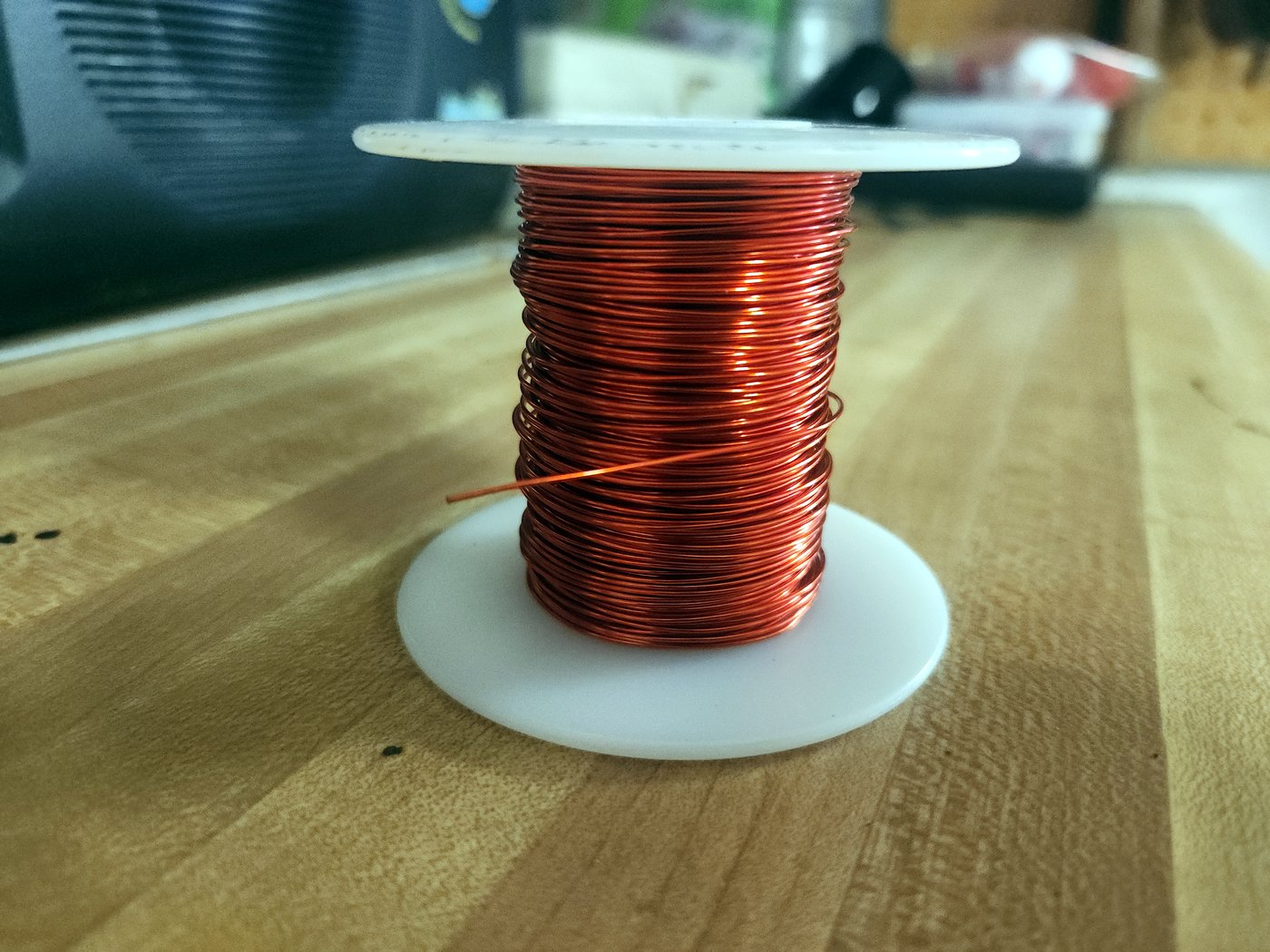
Skip the kit. Kits pre-wind the coil, and winding the coil is where the learning lives - a hundred careful turns teach you more about radio than any finished product can. You need exactly four things: a form to wind on (the oatmeal box is traditional; any sturdy tube works), a spool of 22 AWG enameled magnet wire (Amazon) - the set in the photo is wound from exactly this red spool, and one pound is enough for the coil, the antenna experiments, and the next three projects - a 1N34A germanium diode (Amazon) (a few dollars for a lifetime supply), and a proper crystal earphone (Amazon) - about ten dollars, and the one part you can't improvise: a modern earbud will not work, its impedance is too low and it needs power the set doesn't have. Then: the longest, highest wire you can rig, a real ground, a quiet night - AM travels at night - and a slow sweep of the coil until a voice appears out of nowhere, running on nothing.
Scouting still awards the Radio merit badge, and this build is still the heart of it.