
The ARRL radiogram: moving a message accurately when nothing else works
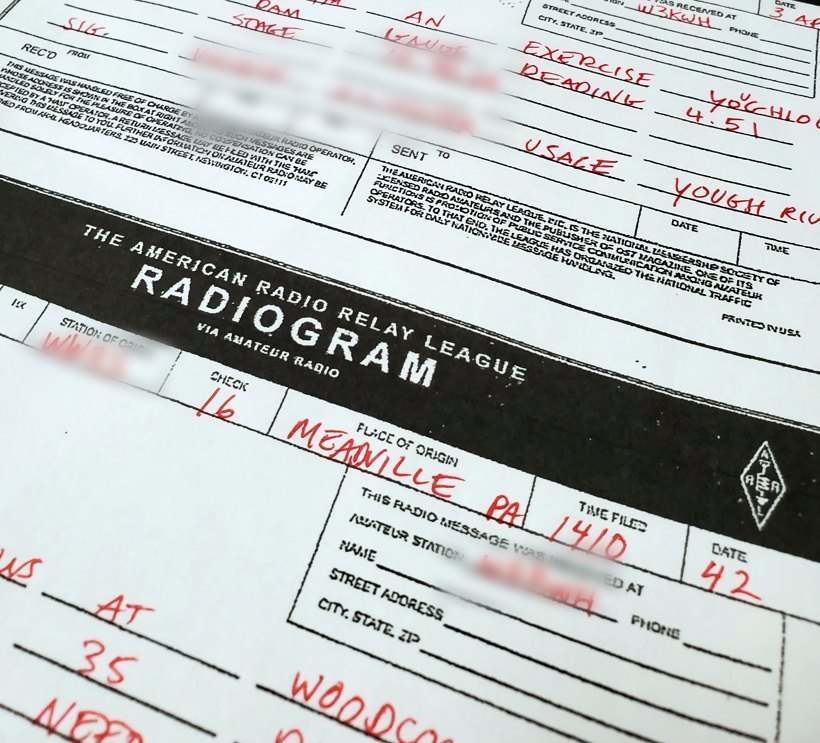
After a hurricane takes down the cell towers, the most valuable message in the world is three words long: we are okay. Getting those words from inside the disaster zone to a worried relative two states away - accurately, verifiably, with no operator quietly dropping a word along the way - is a solved problem. Amateur radio solved it a century ago, and the solution is a paper form: the ARRL radiogram.
Why a form
Voice fades, relays garble, and "just tell them what I said" falls apart the moment a message crosses more than one operator. A radiogram passes through a chain - the station in the disaster zone hands it to a regional station, who hands it to one near the destination, who finally phones or emails the family. Three or four people, none of whom know the sender. The rigid form is what keeps the message intact across all those hands. Every field has one job, and one of them - the check - can actually catch an error before it reaches the family. It's a paper protocol with built-in error detection, designed decades before the word "protocol" meant this.
The four parts
Every radiogram has the same four sections, always in the same order.
1. The preamble - the routing header. It carries a message number (assigned by the first station), a precedence (how urgent - see below), the station of origin (the ham callsign that put it into the system), the check (the word count of the text - more on this shortly), the place of origin (where the sender actually is), and the date. It's the envelope, the postmark, and the tracking number rolled together.
2. The address - who it's for: name, street, city, state, ZIP, and a phone number, because the last station in the chain usually delivers by making a phone call. Spelled out with phonetics when a name is unusual, so "Featherstone" doesn't arrive as "Featherston."
3. The text - the message itself, capped at 25 words. The limit is deliberate: it forces brevity, keeps airtime short, and makes the word count meaningful. This is where hams lean on a clever shorthand (below) to say a lot in very few words.
4. The signature - who it's from. Just the name; the address was already carried in the preamble's place-of-origin.
The check: error detection on paper
The check is simply the number of words in the text - if the text is "ARRIVED SAFELY ALL WELL SEE YOU SOON," the check is six - the number that goes in the CHECK box on the form. The receiving operator counts the words as they copy them. If the sender said the check was six and the operator only wrote down five, something got dropped - and they know to ask for a fill before the message goes any further. A word can't silently vanish across a four-station relay, because every station re-verifies the count.
ARL numbered messages: saying a lot in one word
Most disaster traffic says the same handful of things - I'm safe, I'm coming home, happy birthday, get well soon. Rather than spell those out every time (and risk garbling them), the ARRL publishes a numbered list of standard texts. ARL SIXTY ONE means "Wish you a speedy recovery." ARL FORTY SIX is a birthday greeting. ARL SIX means "Will contact you as soon as possible." The operator sends the number; the delivering station reads the full sentence off the standard list. Common sentiments travel as two words instead of ten, arrive without garbling, and the "ARL" in the check tells everyone the text contains one of these numbered messages.
Precedence: how the system triages
Four levels, and they decide what moves first when the bands are busy:
- EMERGENCY - spelled out, never abbreviated. Danger to life or property, right now. It jumps the queue.
- Priority (P) - important messages with a time limit; official disaster traffic.
- Welfare (W) - the "I'm okay" and "are they okay" messages. After a disaster this is the bulk of the load, and it's exactly what lets families reconnect when the phones are down. The Salvation Army's SATERN net exists to move precisely this welfare traffic out of a disaster zone.
- Routine (R) - everything else, moved as time allows. Most traffic on a normal day.
A welfare message that says "we are safe" isn't an emergency, but it's the reason the system exists.
Where this lives today
It's the working format of the National Traffic System (NTS) - a daily lattice of on-air nets where hams pass practice traffic across the country, keeping the relay skills sharp for the day a real disaster loads them up. It rides alongside ARES (the emergency-communications volunteers) and increasingly moves over Winlink, a system that carries the same structured messages as email over radio when the internet is gone.
How to actually send one
You can't originate radiogram traffic without a license - putting a message into the system means transmitting, and that's the Technician exam's territory (35 questions, no Morse code). But the moment you have a callsign, you can check into an NTS net - they are famously welcoming to newcomers, and passing your first practice message is a rite of passage. Search "[your state] NTS net" or ask at a local club; someone will walk you through your first radiogram on the air.
When the network dies and you need to get word out, the message that travels is short, it's structured, and somewhere a licensed operator is standing by to relay it.