
How far will a VHF radio reach?
It's the first question everyone asks about a two-way radio, and the answer annoys people: it depends almost entirely on what's between the two antennas, and hardly at all on the watts printed on the box. VHF and UHF travel in nearly straight lines, so their everyday range is a story about horizons. But "line of sight" makes these radios sound far more limited than they are: when the conditions are right, VHF reaches well past the horizon.
The one rule: line of sight
The shortwave bands you may have heard about (HF, the amateur "talk to another continent" frequencies) work by bouncing signals off the ionosphere, high overhead, back down to earth hundreds or thousands of miles away. VHF and UHF do not do this. The FRS and GMRS walkie-talkies, the 2-meter ham handheld, marine and aviation radios, NOAA weather transmitters, the practical two-way world - these live on frequencies that mostly punch straight through the ionosphere and keep going into space. What comes back down toward the horizon travels in a nearly straight line, like light from a flashlight.
That single fact governs everything else. If the two antennas can "see" each other - no hill, no building, no bulge of the earth in the way - they can talk. If they can't, no reasonable amount of power fixes it. This is why height matters far more than watts. Doubling your transmit power buys you a barely-noticeable sliver of extra range; raising your antenna thirty feet can double it.
The radio horizon
Because the atmosphere bends radio waves gently downward, the radio horizon sits a little farther out than the visual one. A useful rule of thumb: the distance to your radio horizon in miles is about 1.4 times the square root of your antenna's height in feet. Two stations add their horizons together.
| Antenna height | Radio horizon |
|---|---|
| Handheld at head height (~6 ft) | about 3.5 miles |
| Two handhelds, flat open ground | about 7 miles, best case |
| Antenna on a 30 ft mast | about 8 miles to the horizon |
| Repeater on a 500 ft tower | about 30 miles - and it can hear your handheld from anywhere in that radius |
| An airliner at 35,000 ft | about 250 miles |
Ground-to-ground between two people is short - a few miles - because both antennas are low and the earth curves away between them. The moment one end gets high, everything changes. That's the reason repeaters exist: put a radio up on a tower or a mountain, let it relay, and two handhelds that could never reach each other directly both reach the repeater and talk across a county. It's also why you can hear aircraft from so far away - the airplane is doing the "get high" part for you.
Your horizon, calculated
Enter an antenna height and read the distance to your radio horizon under ideal conditions - open water, nothing in the way, like a boat's antenna looking out to sea. For two-way range between two stations, run it for each antenna and add the results.
Why the box says "35 miles"
Now the packaging makes sense. That "35-mile range" on a blister pack of FRS radios isn't a lie so much as a lab result from an impossible situation: two radios on adjacent mountaintops with nothing between them, which is exactly two radio horizons of about 17 miles each, added together. In a real neighborhood - houses, trees, the curve of the ground - the same radios do a few blocks to a couple of miles, which, as the family radio guide argues, happens to be exactly the range a separated household actually needs.
When the horizon bends: tropospheric ducting
On certain days the lower atmosphere - the troposphere, the weather layer we all live in - stacks up warm air on top of cooler air. That "temperature inversion" is upside-down from normal: instead of letting VHF and UHF signals refract slightly and escape upward to space, it bends them hard enough to curve them back toward the ground. The signal gets trapped between the inversion layer above and the earth or sea below, and it skips along inside that channel like light down a fiber-optic cable. Radio operators call it a duct, and the effect tropospheric ducting.
When a duct forms, the normal horizon simply stops applying. A handheld or a scanner that reaches a few miles on a Tuesday can suddenly pull in signals from several hundred miles away, occasionally more than a thousand - distant FM and TV stations, out-of-state repeaters, aircraft and ships far past where any horizon math says they should be. The conditions that build ducts are worth knowing because they're common and somewhat predictable:
- Over water and along coastlines, where a cool sea under warm air makes a marine-layer inversion almost routine - the classic ducting environment.
- Under stable high-pressure systems, especially the calm, clear days when the air isn't mixing.
- At dawn and dusk, as the ground cools faster than the air above it.
- In warm, humid weather more than in cold dry snaps.
A picture of it: the beach
The most vivid demonstration I've caught is aircraft tracking from the beach. A cheap SDR receiver picking up the position signals that airplanes broadcast will, on an ordinary day inland, map traffic out to a couple hundred miles - respectable, and mostly just the line-of-sight-to-a-high-airplane effect from the table above. Set the same receiver up at the shore, though, with a marine inversion sitting over the water, and the map blooms: planes appearing hundreds of miles out over the ocean, well beyond any line-of-sight horizon.
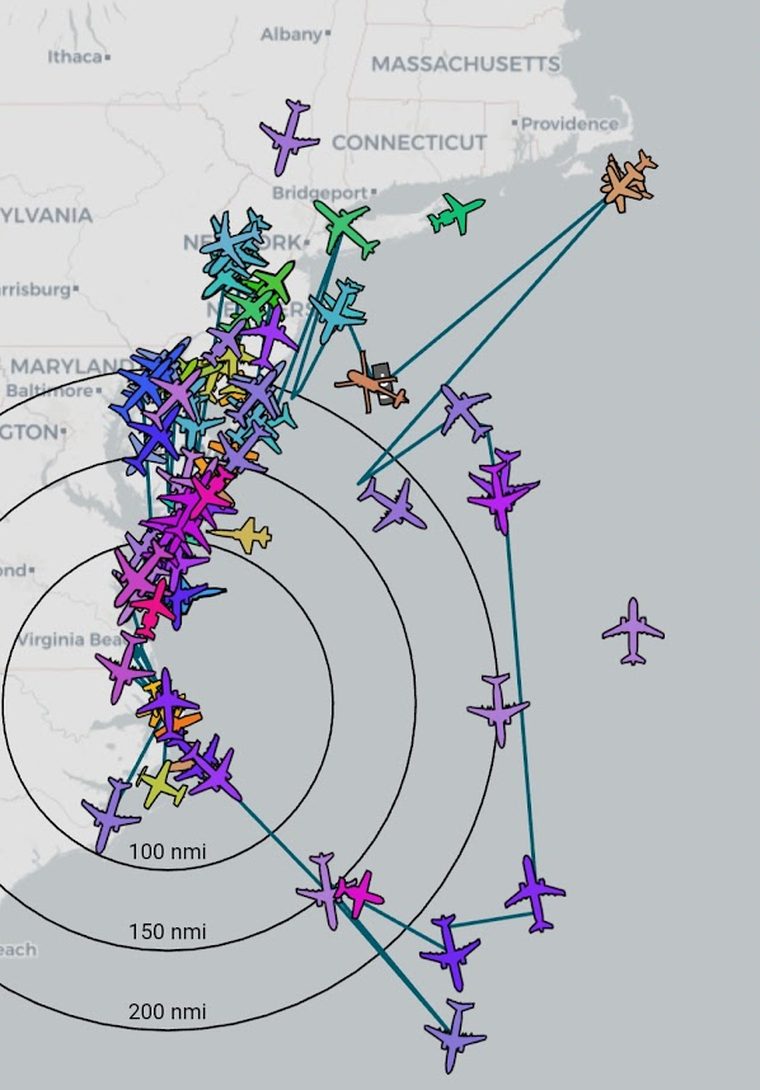
The rig that captured this is deliberately humble: a Raspberry Pi 3 (Amazon), an RTL-SDR v3 dongle, and a homemade antenna, running two free, open-source packages - readsb, which decodes the 1090 MHz signals aircraft broadcast off the dongle, and tar1090, the web map pictured here. The Pi runs about $50 (you supply a microSD card); with the dongle and a few dollars of wire, it's around a hundred dollars of parts on a beach towel.
Each aircraft is colored by its altitude, and a high jet showing up far offshore is no surprise - a plane at 35,000 feet is supposed to clear a 250-mile horizon; that's just the table above doing its job. The startling part is the low, slow traffic out near Nantucket, hundreds of miles from the receiver. A low aircraft has almost no radio horizon - by line of sight it should be flatly invisible at that range. Only a duct explains it: the atmosphere bending the signal back down and carrying it far past where the curve of the earth should have swallowed it.
A fair note for the technically minded: those aircraft signals ride on a frequency just above the VHF band, in the UHF range. The distinction doesn't matter for the point, because ducting grabs VHF and UHF alike - if anything it tends to favor the higher frequencies. What you're looking at is the same atmosphere, doing the same trick, that now and then lets a two-meter handheld work a station three states away.
What it means for you
- Plan for line of sight; treat ducting as a gift. Size your expectations to the horizon table above - a few miles ground-to-ground, much more to anything up high. Ducting is real but unpredictable; never build a safety plan around a bonus the weather might not grant.
- Height beats power, every time. Before you shop for a more powerful radio, get your antenna up and clear. It's the cheapest range upgrade there is, and physics is on its side.
- Reach for a repeater when you need distance. Borrowing a tower's height is how modest handhelds cover real ground - the reason a ham license and the local repeaters it unlocks turn a pocket radio into county-wide reach.
- Recognize a duct when you're in one. If your scanner or weather radio suddenly fills with stations that shouldn't be there, the band is probably "open." Near the coast, expect it more often - and enjoy hearing a great deal farther than usual while it lasts.
So don't let "line of sight" fool you into thinking VHF is short-range. Most days a handheld does its few line-of-sight miles - but let the atmosphere line up, and that same little radio reaches clear over the horizon.