
Building a transmitter for a STEM project: what the FCC actually allows
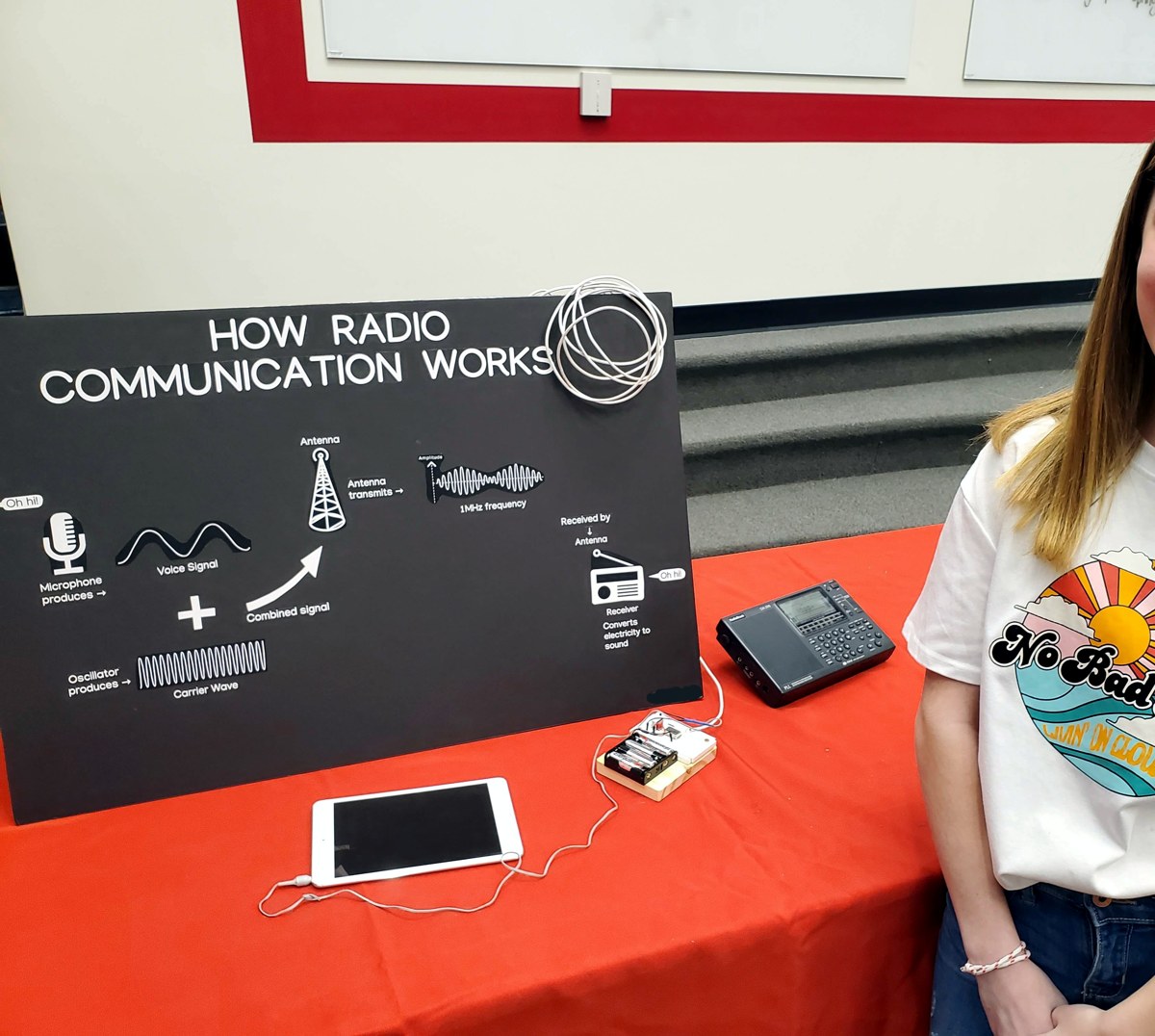
Every good radio STEM project eventually hits the same question, usually from a cautious parent or a careful teacher: wait - is it legal to transmit? In our house it arrived exactly that way - with the science-fair project in the photo above. The answer is better than most people expect: yes, within limits that are generous enough for real learning and specific enough to print. The rules live in FCC Part 15, they've been stable for decades, and this page is the plain-English version.
Receiving is always fair game
Listening requires no license, ever. A crystal set, a shortwave portable, a software-defined radio dongle sweeping the spectrum - all legal, no paperwork, no age requirement. A receiver emits nothing; the FCC regulates what goes out of an antenna, not what comes in. If the project is a receiver, build freely and skip to the bench.
The home-built exemption most people have never heard of
Here's the rule that makes hobby transmitters legal at all: FCC Part 15.23, "Home-built devices." If you build five or fewer of something, for personal use, not for sale, you don't need the certification testing that commercial gadgets go through. You're expected to use good engineering practice to stay within Part 15's emission limits - but the law explicitly carves out space for exactly the thing a STEM project is.
The limits that apply are the same ones every unlicensed gadget lives under, and they differ sharply by band:
The AM band: the generous one
Part 15.219 allows an unlicensed AM-band transmitter with:
- 100 milliwatts of power into the final stage - a tenth of a watt, and
- 3 meters total of antenna, feedline, and ground lead, combined.
In practice it covers a house and yard - a couple hundred feet - which is why this is the rule behind "talking house" real-estate transmitters and the boxes that feed music to antique radios. For a STEM build it's ideal: a one- or two-transistor AM transmitter on a breadboard, a voice or a music source, and a receiver across the room pulling it in. Fully legal, no license, at any age.
The FM band: legal but nearly a whisper
FM is a different story. Part 15.239 limits unlicensed FM to a field strength of 250 microvolts per meter, measured at 3 meters - an emission so small it works out to a range of tens of feet. That's exactly the allowance your old iPod-to-car-radio adapter used.
You can build an FM transmitter under this rule, and a one-transistor FM bug that barely reaches the kitchen is a fine project. One warning: many imported "FM transmitter kits" exceed this limit as shipped - some by a lot. A kit reaching your neighbor's house isn't a better kit; it's an illegal one.
Where the line actually is
The FCC's enforcement energy goes where the interference goes: unlicensed FM stations covering neighborhoods - pirate radio - now carry fines that run to six figures per day under the PIRATE Act. Nobody is fining a science fair. But the reason the science fair is safe isn't that the FCC is lenient - it's that a compliant project can't hurt anything.
- Interference is disqualifying at any power. Even a compliant Part 15 device must stop operating if it interferes with licensed services. If your project ever lands on top of something, move frequency or shut down - that duty is written into the rule.
- Stay in the broadcast bands. The AM and FM allowances above are for those bands specifically. There is no tinkering allowance on aviation, public-safety, marine, or FRS/GMRS frequencies - certified equipment only there, no home-built transmitters at all.
When the project outgrows 100 milliwatts
There's a legal path to real power and real range, and it costs about $15: the amateur radio license. A Technician exam is 35 questions from a public pool, and it changes the rules completely - because in the ham bands, home-built transmitters need no certification at all. Licensed amateurs run homemade equipment at up to legal-limit power; building your own gear isn't just permitted there, it's the culture. The progression is natural: crystal receiver → Part 15 AM transmitter → license → the full spectrum of homebrew.
The questions that carry the project
When I helped my daughter build hers, the electronics turned out to be the easy half. The teaching was a running list of questions, and the build answered them one at a time. If you're the parent or teacher, work from questions like these and let the hardware do the explaining:
- Making the wave: What actually makes the radio wave - what's an oscillator? What's a carrier wave, and why do you need one when it carries no sound by itself? What does the antenna do to get it into the air?
- Putting the voice on and taking it off: What does a modulator do to the carrier? What's the difference between changing a wave's amplitude and its frequency - and which did we just build? How does the receiver undo it all (and why does that job - demodulation - turn out to be a single diode in the simplest radio ever made)?
- Picking one signal out of the air: Why doesn't the receiver hear every station at once? What's resonance - and where else in life does the same physics show up? What's a tuned circuit made of?
- The bigger picture: Which waves travel farthest, and why does AM go so much further at night? Who sorted out the first radio transmissions, and what did Marconi actually prove? And the question that led to this page: who gets to decide what you're allowed to transmit - and what do they say?
That last one has a satisfying answer for a curious kid: the FCC wrote a rule specifically for people like her. That's §15.23, above.
The bench list
- Start with the receiver: the crystal set - the same magnet wire (Amazon), diode (Amazon), and earphone (Amazon) serve both projects.
- First transmitter: a one-transistor AM oscillator on a breadboard, modulated by a phone's headphone output - a classic circuit found in any hobby electronics text, legal under 15.219 with a short antenna.
- Prove it end to end: transmit across the room to the crystal set you built. A complete radio link, both ends homemade, zero licenses - and every principle on the principles page demonstrated live.
Skip the "turn a Raspberry Pi GPIO pin into an FM transmitter" trick that circulates online. It radiates square-wave harmonics across half the spectrum with no filtering - the textbook opposite of good engineering practice, and not what §15.23 protects.